

Your furniture ad budget is not the problem. Your product pages are
After working 5 years as a digital marketer, I saw that the average furniture eCommerce brand converts between 1.2% and 1.6% of its traffic into sales – which means up to 98 out of every 100 visitors leave without buying. Meanwhile, ad CPCs keep climbing, ROAS keeps shrinking, and the C-suite keeps asking the same question: “How do we grow revenue without growing the ad budget?”
The honest answer is
- Most furniture brands are pouring spending into the top of the funnel
- A broken buying experience is bleeding customers out the bottom
- The fix is not more ads, it is a better conversion experience
Wheel working, a modern furniture company in last year and fixed the buying experience – not the ad spend – and recorded a 49% increase in conversion rate alongside a 211% jump in user engagement. DFS implemented 3D furniture modeling across more than 10,000 SKUs and achieved a 22x return on that single investment.
The strategies below are the seven levers that deliver the most measurable revenue impact without touching your paid media budget. One of them – the one most furniture marketers are still ignoring in 2026 – is the single fastest way to close the gap between the traffic you already have and the sales you should already be making.
In this guide you will get 7 Proven Ways to Increase Furniture Online Sales Without Increasing Ad Spend.
At a Glance – 7 High-Impact Levers to Boost Sales Without Ad Spend
# | Strategy | Key Metric | Time to Impact |
1 | 3D Product Visualization | +94% CVR (Shopify data) | 30–60 days |
2 | Conversion Rate Optimization (CRO) | +35% revenue from 0.5% CVR lift | 30–60 days |
3 | Organic SEO | $100K attributable in year 1 (case study) | 3–6 months |
4 | Email Marketing Automation | $42 ROI per $1 spent | 1–4 weeks |
5 | User-Generated Content (UGC) | +154% revenue per visitor | 30–90 days |
6 | Organic Social | Compounding reach via visual quality | Ongoing |
7 | Augmented Reality (AR) | 8x more likely to convert | Post 3D asset build |
What Is Conversion Rate Optimization – and Why It Comes Before Every Other Strategy
Conversion Rate Optimization (CRO) is the process of increasing the percentage of website visitors who become customers. Instead of spending more money to attract new traffic, CRO helps you generate more sales from the visitors you already have.
Furniture Ecommerce Benchmarks (2025–2026)
Metric | Average Performance |
Conversion Rate | 1.2%–1.6% |
Visitors Who Leave Without Buying | Up to 98% |
Revenue Increase from Improving CVR (1.4% → 1.9%) | +35% |
Additional Traffic Required | None |
If your conversion rate is below the industry average, increasing ad spend will not solve the problem. It will simply send more traffic into a funnel that is already leaking potential sales.
“What Should Furniture Marketing Managers Do First for Increasing Conversation?”
The first place to look is your product page.
Research from the Baymard Institute shows that 56% of shoppers view product images immediately after landing on a product page. Before checking pricing, shipping options, or reviews, customers evaluate the visual presentation of the product.
In most cases, shoppers make an initial trust decision within the first few seconds.
Buyers Usually Evaluate Products in This Order
- Product Images
- Price
- Delivery Information
- Customer Reviews
Many furniture brands invest heavily in pricing strategies and shipping promotions while overlooking the element buyers examine first: product visuals.
Other CRO Areas That Impact Sales
Beyond product imagery, furniture brands should regularly review:
- Mobile user experience
- Website loading speed
- Product page usability
- Checkout process
- Cart abandonment points
Because furniture purchases involve higher prices and longer consideration periods, even small amounts of friction can reduce conversions.
Every additional step between “Add to Cart” and “Order Confirmed” creates another opportunity for shoppers to leave without purchasing.
Why Your Product Visuals May Be Hurting Conversions
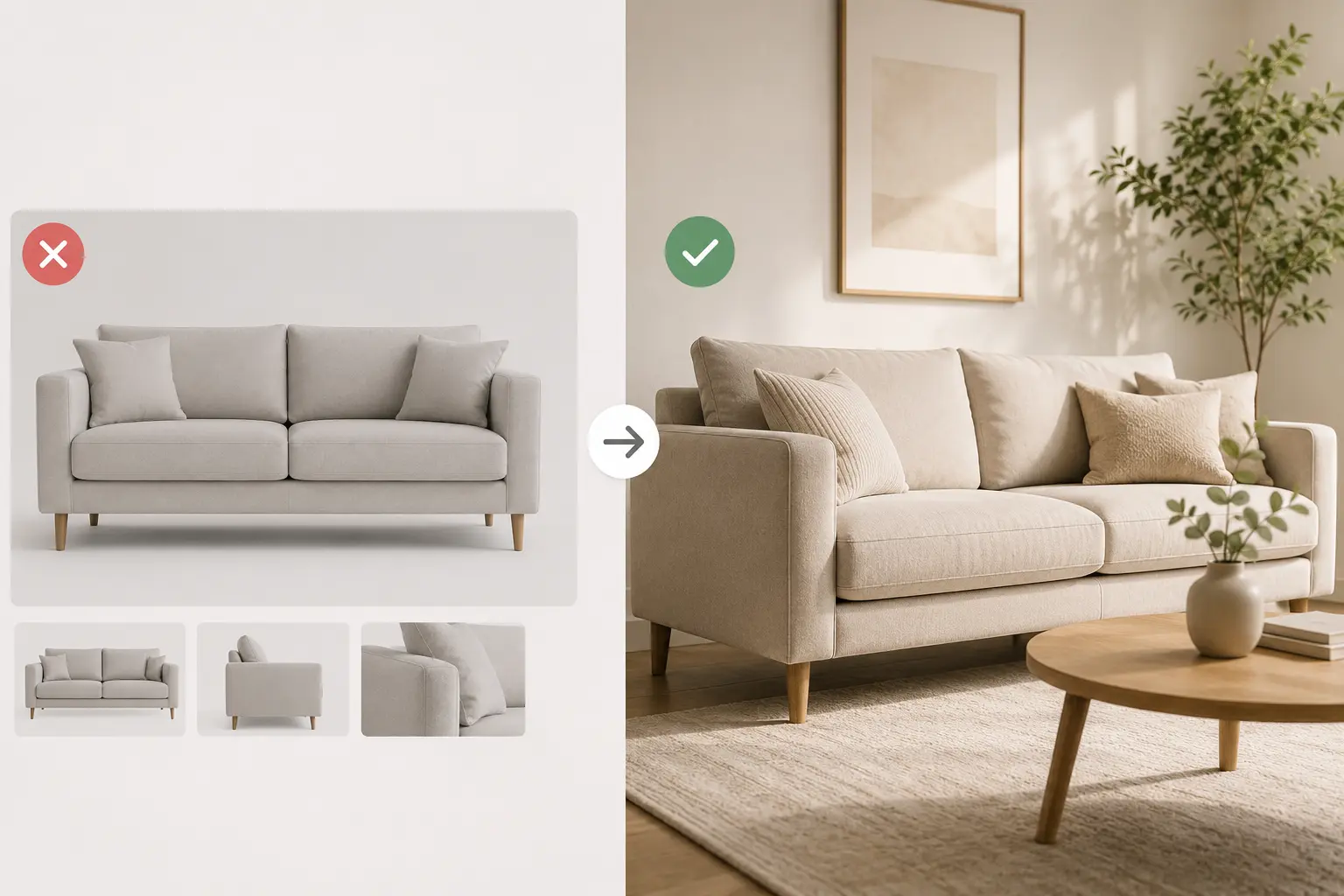
Traditional product photos often fail to answer important buyer questions about size, materials, colors, and how furniture fits into a real space. This uncertainty creates hesitation and lowers conversions.
How 3D Visualization Helps
With 3D product visualization, shoppers can:
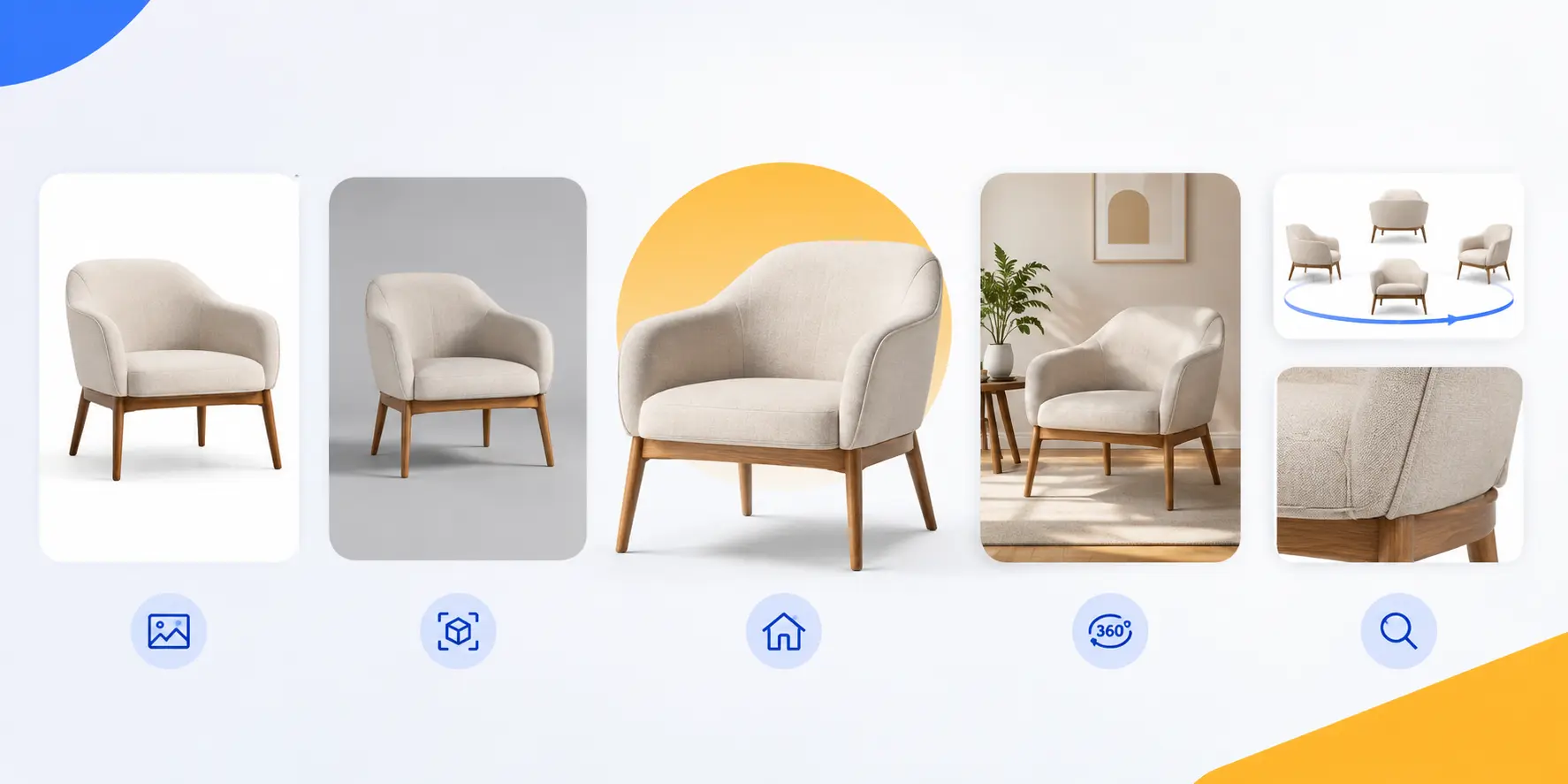
- Rotate products 360°
- Zoom into materials and textures
- Switch colors and configurations
- View products in realistic room settings
This creates more confidence and reduces purchase hesitation.
Research Highlights
Source | Result |
Shopify | +94% Conversion Rate |
Cylindo | +64% Purchase Intent |
Harvard Business Review | +19.8% More Purchases |
Real Furniture Brand Results
Brand | Result |
Jerome’s Furniture | +49% Conversion Rate |
EQ3 | +36% Conversion Rate |
Heal’s | +100% Sofa Sales |
DFS | 22× ROI |
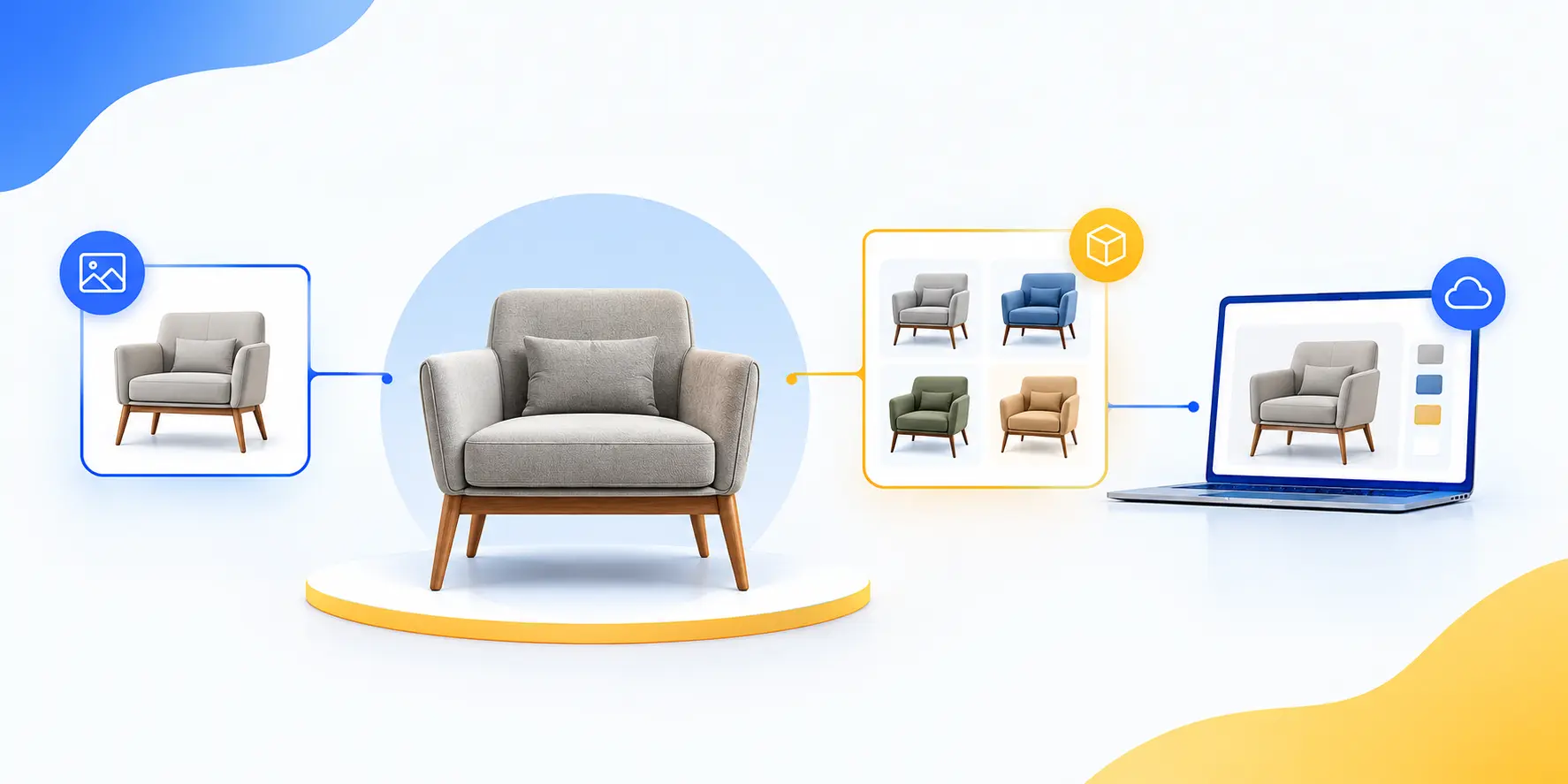
The biggest advantage is that one 3D model can generate furniture product images, lifestyle renders, 360° viewers, email assets, and AR-ready files-making it valuable across every marketing channel.
How Organic Search Compounds (SEO) Revenue Over Time – Without Recurring Spend

Organic search is the only marketing channel that generates compounding returns. Every other channel – paid social, display, even email – stops producing the moment you stop paying for it or sending it. A well-optimized product page or buying guide that ranks on page one of Google continues generating qualified traffic for years after the initial investment in writing and optimization.
For furniture brands, the SEO opportunity in 2026 is concentrated at two levels: product pages and content marketing.
- Product Page SEO: Target specific, high-intent keywords (e.g., “cream linen 3-seater sofa”) to attract buyers who are ready to purchase. Adding product, review, 3D model, and FAQ schema can improve search visibility and click-through rates.
- Content Marketing: Publishing buying guides that answer purchase-related questions can generate qualified traffic for years. Topics such as furniture sizing, style comparisons, and buying decisions help attract customers in the final stages of the buying journey.
3D Visualization & SEO Optimized 3D renders with descriptive file names, alt text, and structured data can improve visibility in image and visual search results. A library of 3D assets provides furniture brands with a scalable source of SEO-friendly visual content that continues to drive traffic over time.
Email Marketing: The Highest-ROI Channel for Furniture Brands
Email marketing delivers an average $42 return for every $1 spent, making it one of the most profitable channels for furniture retailers. Since furniture purchases often involve weeks of research and comparison, email helps keep your brand visible until buyers are ready to purchase.
High-Performing Email Automations
Automation | Purpose |
Browse Abandonment | Re-engage visitors who viewed products but didn’t add to cart |
Cart Abandonment | Recover potential customers who showed buying intent |
Post-Purchase | Collect photo reviews and recommend complementary products |
Re-Engagement | Bring inactive customers back with new collections |
Best practices:
- Use lifestyle images instead of plain product photos.
- Show products in realistic room settings.
- Send personalized follow-up emails based on customer behavior.
- Leverage 3D renders to create fresh campaign visuals without new photoshoots.
Building a UGC Engine That That Increases Conversions
Many furniture brands use user-generated content (UGC) mainly for social media engagement. However, its biggest impact comes from product pages, where it directly influences purchase decisions.
Why UGC Matters
- Product reviews can increase conversions by 74%.
- UGC pages generate higher revenue per visitor.
- Shoppers trust customer photos more than branded content.
- Real-home images provide credibility that studio visuals cannot match.
UGC Collection Process
- Deliver the furniture.
- Send a review request after 30 days.
- Offer a small incentive for photo submissions.
- Display customer photos directly on product pages.
Best approach: Combine professional 3D renders for inspiration with UGC for social proof.
Organic Social: Visual Quality Drives Revenue

Success on platforms like Pinterest, Instagram, and TikTok depends less on posting frequency and more on visual quality.
Content That Performs Best
- Styled room scenes
- Before-and-after transformations
- Product reveal videos
- Lifestyle-focused imagery
- Multiple room configurations
Why 3D Assets Matter
One 3D furniture model agency like orbe3de can generate the following:
- Website product images
- Pinterest lifestyle visuals
- Instagram content
- Seasonal campaign creatives
- Animated videos for Reels and TikTok
Key advantage: Unlike traditional photography, 3D assets can be reused and updated endlessly, giving furniture brands a scalable content production system.
Organic Social as a Revenue Channel: Why Visual Quality Matters Most
Most advice about organic social media for furniture brands focuses on tactics such as posting consistently, using trending sounds, creating Pinterest boards, or adding hashtags. While these tactics can help, they do not address the factor that has the greatest impact on performance:
Visual quality.
For furniture brands, social media success is largely determined by how products are presented. High-quality lifestyle imagery consistently attracts more engagement, saves, shares, and clicks than standard product photography.
Why Visual Quality Drives Results
Pinterest is one of the highest-intent social platforms for furniture shoppers. Users save and click on content that inspires them.
A sofa displayed in a beautifully styled living room is far more likely to be saved than the same sofa shown on a plain white background. More saves lead to greater distribution, creating a compounding effect on organic reach over time.
Instagram and TikTok
The same principle applies to video content.
Formats that consistently perform well include:
- Cinematic room tours
- Product reveal videos
- Before-and-after room transformations
- Lifestyle-focused furniture showcases
These formats help customers visualize products in real spaces, making them more engaging than static product shots.
How 3D Assets Create a Content Advantage
One photorealistic 3D furniture model can be repurposed into multiple marketing assets.
From One 3D Model | Possible Outputs |
Website Content | White-background product images |
Styled lifestyle renders | |
Alternative room configurations | |
Campaign Launches | Seasonal color and setting variations |
TikTok & Reels | Animated product videos |
Instead of organizing new photoshoots for every campaign, brands can generate fresh content from existing 3D assets.
Read more : What Is 3D Furniture Modeling? Complete Beginner Guide 2026
Traditional Photography vs. 3D Assets
Traditional Photography | 3D Asset Library |
Limited to what was captured during the shoot | Can be re-rendered indefinitely |
Requires photographers, locations, and scheduling | Faster content creation |
New campaigns often require new shoots | Existing models can be reused |
Higher production costs over time | Scalable content production |
As a result, brands with 3D asset libraries can plan content around marketing needs rather than photography availability.
AR and Room Visualization: A Competitive Advantage
Augmented Reality (AR) is quickly becoming a standard expectation for furniture shoppers.
Research shows that customers who use AR tools are significantly more likely to purchase because they can visualize products in their own spaces before buying.
Key Statistics
Metric | Result |
Customers using AR | 8x more likely to convert |
Shoppers using 3D tools in-store | 67% more likely to purchase products over $2,500 |
Consumers interested in using AR daily | 76% |
Shoppers who would buy more frequently with AR | 71% |
The Real Barrier Isn’t Technology
Many marketers assume AR requires expensive technology. In reality, platforms such as Shopify, Google, iOS, and Android already provide accessible AR capabilities.
The actual requirement is a high-quality 3D model.
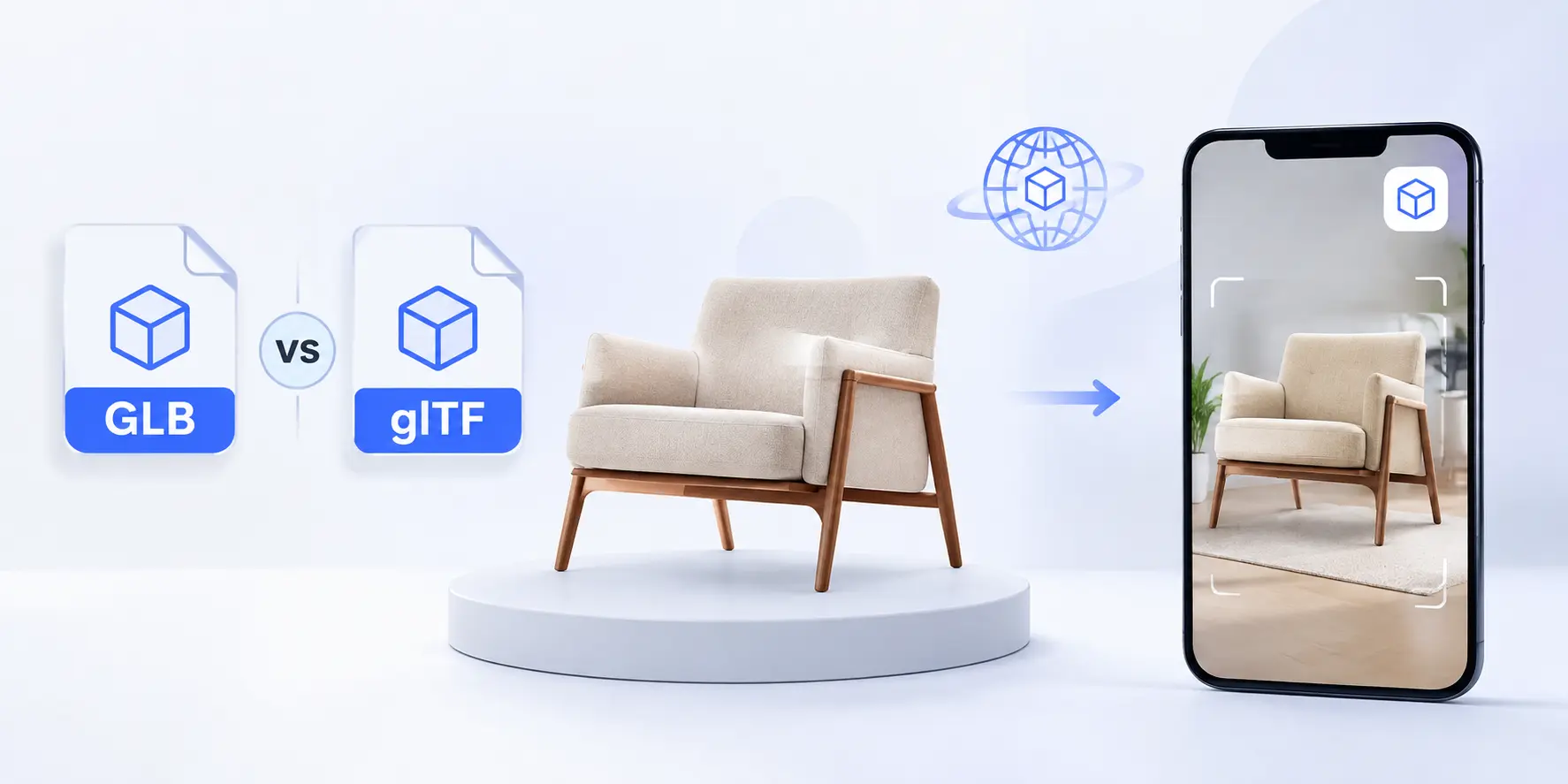
Without properly optimized 3D assets (typically in glTF or USDZ formats), AR experiences cannot be created regardless of the e-commerce platform being used.
Why 3D Modeling Is More Than a Visual Upgrade
Investing in 3D modeling unlocks multiple sales and marketing channels:
- Website AR experiences
- “View in Your Room” features
- AR-powered social commerce
- Visual search integrations
- Future AR shopping experiences
All of these channels depend on the same foundational asset: a production-quality 3D model.
Conclusion
In 2026, furniture e-commerce success depends on one key factor: buyer confidence. Whether through CRO, SEO, email marketing, UGC, social media, or AR, the goal is the same-help shoppers feel confident enough to buy.
At the center of these strategies is high-quality visual content. Professional 3D product visualization helps customers better understand products, improves product page performance, supports marketing campaigns, and enables AR experiences.
Furniture brands that invest in scalable 3D assets gain a competitive advantage across multiple channels, while those relying solely on traditional photography risk falling behind.
If you’re ready to improve your product presentation and create assets that support every stage of the buyer journey, Orbe3D can help. With 10+ years of experience, 1,100+ completed projects, and 35+ furniture brands served across the US and Europe, we help furniture companies create high-quality 3D models that drive results.
Not ready to commit? Try our free trial and discover how professional 3D furniture models can transform your product presentation.
Frequently Asked Questions
Q: What is the fastest way to increase furniture online sales without increasing ad spend?
Improve your product pages. Better product visuals, especially 3D renders, can increase conversions without increasing advertising costs.
Q: How much can 3D visualization improve furniture eCommerce conversions?
Furniture brands report conversion increases of 36%–94% after adding high-quality 3D product visualization.
Q: Is email marketing still worth it for furniture brands in 2026?
Yes. Email marketing delivers an average ROI of $42 for every $1 spent and works especially well for furniture’s longer buying cycle.
Q: Where should furniture brands display UGC for the best results?
On product pages. Customer photos and reviews provide social proof at the point of purchase and can significantly improve conversions.
Q: What is needed to offer AR “View in Your Room” experiences?
A high-quality 3D model in GLB or USDZ format. Once the model exists, most AR platforms are easy and affordable to implement.