
How a scaling furniture brand cut $10,000 a month with 3D visualization
By replacing repeated physical photo shoots with a reusable digital-twin pipeline — modeled, staged, and rendered by Orbe3D under white label.
Net reduction in monthly visual-production & return-handling cost — approx. $120,000 annualized.
Key Takeaways
$10,000 in monthly savings was the confirmed result for this engagement.
$120,000 annualized run-rate saving in recurring bottom-line production expenses.
Reusable digital workflow: 3D changes furniture visualization from a repeated physical production process into a reusable digital workflow.
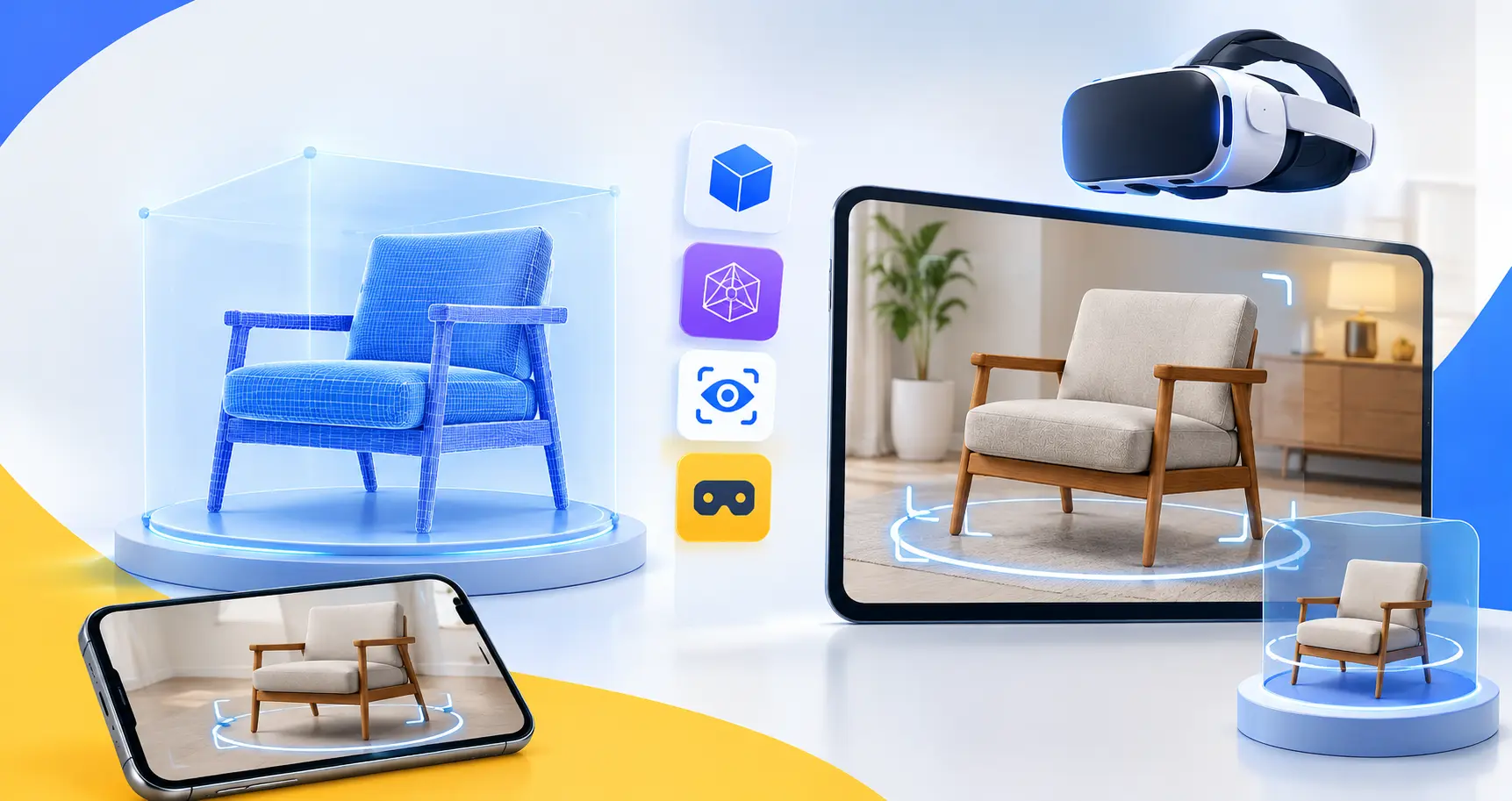
One digital product asset can support renders, variants, lifestyle scenes, interactive 3D, and AR.
GLB/glTF and Shopify ready: GLB/glTF make the workflow suitable for modern web-based 3D experiences, with Shopify supporting GLB and USDZ product models.
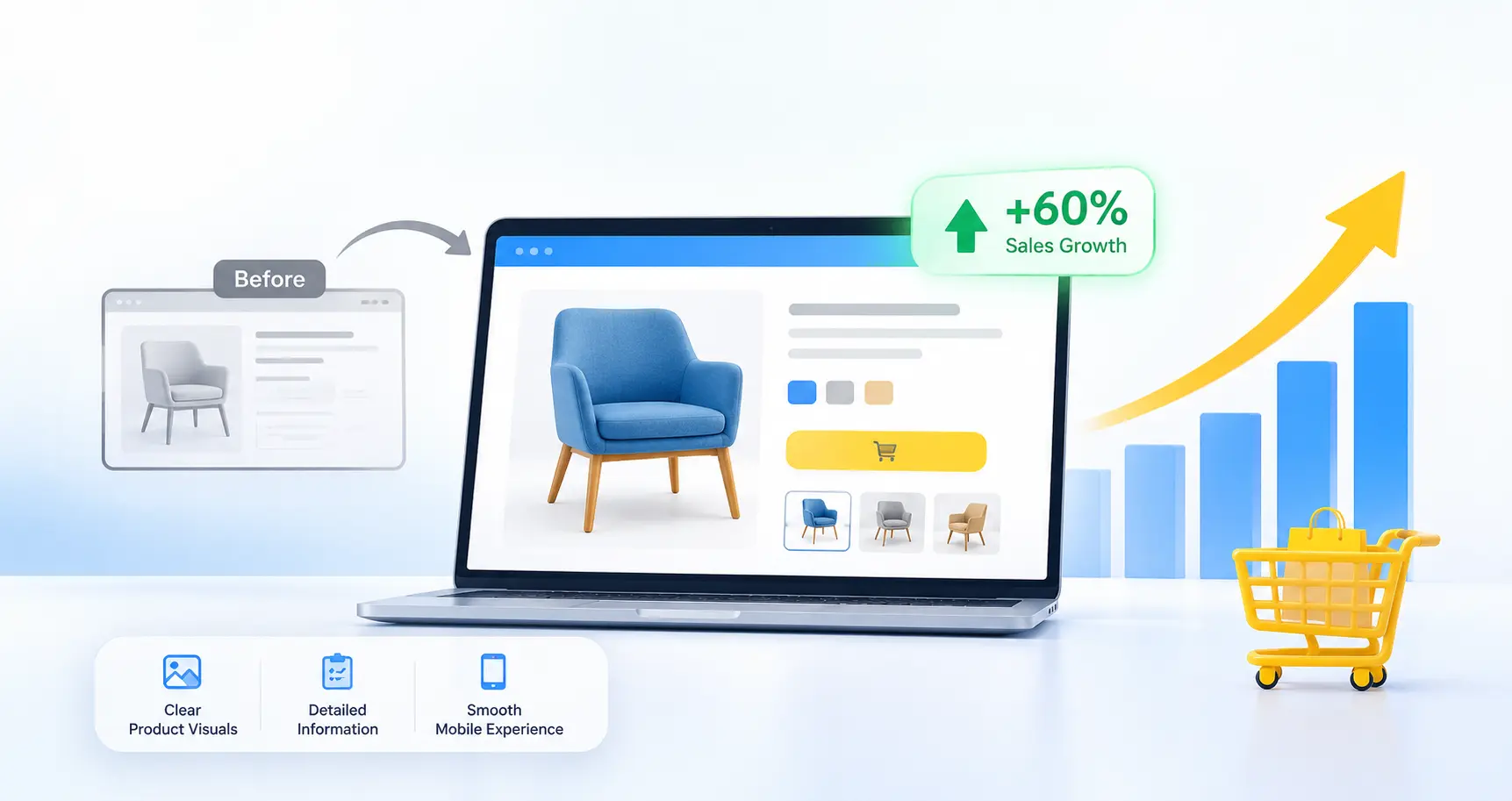
Industry benchmarks vs. client claims: Industry case studies show that 3D/AR can also influence conversion, AOV, revenue, and returns—but those benchmarks should never be presented as this client's results.
Next measurable opportunity is to connect 3D engagement directly to conversion and return data.
About the Client
The client was a fast-scaling, venture-backed premium direct-to-consumer (DTC) home furnishings brand operating primarily in the United States.
The Recurring Growth Problem: Every new SKU, finish, and variant triggered another costly photography and logistics cycle.
The Business Problem
The brand's visual production costs were growing alongside its catalog.
Traditional Furniture Photography
Traditional photography required ↗:
- Physical product samples
- Freight and handling
- Studio scheduling
- Styling
- Photography
- Retouching
- Re-shoots for new variants
The Buyer Expectation Gap
Customers were making high-value furniture purchases without physically seeing the product. A flat photograph cannot fully communicate ↗:
- Scale
- Proportion
- Material texture
- Color under different lighting
- How a product fits within a room
Why Digital-First Wins for Growing Catalogs
Traditional furniture photography costs more than the studio and photographer. Sample delays, freight, scheduling, and repeated shoots for new variants can slow down product launches.
The White-Label 3D Solution
Orbe3D was brought in as a white-label production partner to turn existing manufacturing data into accurate, reusable digital product assets across the brand's visual channels.
1. Source Ingestion
Existing manufacturing data served as the single source of truth for all digital assets.
2. Digital Twin Creation
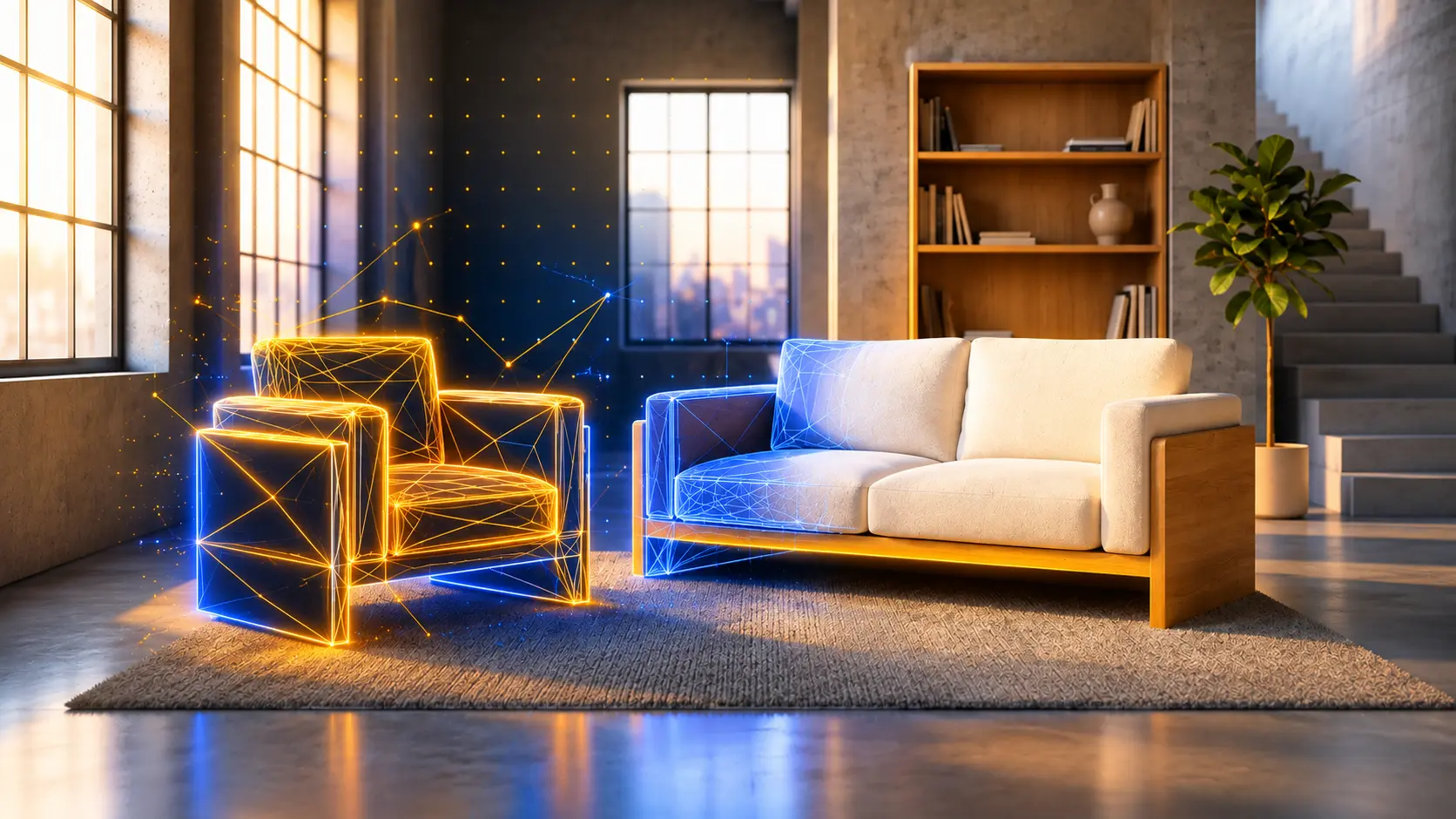
Each product was recreated as a dimensionally accurate digital twin using real manufacturing measurements.
3. Material Development
Materials were recreated using a PBR workflow based on the brand's real fabric and finish references.
4. Virtual Lifestyle Staging
Products were placed into professionally designed digital interiors instead of requiring a physical set for every campaign.
5. Rendering and Variant Production
Final visuals were rendered using Cycles, with Unreal Engine available for real-time and interactive requirements.
6. Web-Ready 3D Delivery
Assets prepared for interactive e-commerce and Shopify 3D media support (GLB, glTF, and USDZ for AR).
7. Production and Deployment
Total 50-SKU Deployment: 40 HoursThe initial library covered approximately 50 SKUs, with assets delivered in production waves on roughly a one-week cadence.
Why the Economics Changed
The advantage was not simply replacing photography with 3D renders. It was changing the entire production model.
Traditional Photography
Creates a new physical production event when products, variants, or scenes change. Every new finish triggers another photoshoot cycle.
Master Digital Twin
Creates a master digital product that can be reused infinitely. For a deeper look at the difference, see our guide to 3D vs. traditional photography ↗ .
One Digital Twin Asset Supports:
9 Multichannel OutputsProduct Renders
Clean white background PDP imagery
Lifestyle Scenes
Contextual digital room environments
New Colorways
Instant fabric and color recoloring
New Finishes
Wood, leather, and metal materials
Additional Angles
Infinite virtual camera placements
Marketplace Imagery
Multi-channel e-commerce compliant
Marketing Campaigns
Seasonal creative and editorial ads
Interactive 3D
360° interactive PDP viewer
AR-Ready Experiences
Augmented reality true-to-scale fit
Transforming Content from an Expense into an Asset
3D is not just a replacement for photography—it creates a reusable digital product asset. One accurate furniture model can support product images, lifestyle scenes, new variants, ads, interactive 3D, AR, and configurators.
How the $10,000 Monthly Saving Was Created
The client achieved a confirmed net monthly saving of $10,000, with total modeled monthly costs decreasing from approximately $13,000 under the traditional visual-production model to $3,000 with Orbe3D.
| Monthly Cost Line | Traditional Model | Orbe3D Model | Net Difference |
|---|---|---|---|
| Studio, photographer, and crew | $3,500 | $0 | -$3,500 |
| Heavy-product freight | $2,500 | $0 | -$2,500 |
| Staging, props, stylist, and retouching | $2,200 | $0 | -$2,200 |
| Sample handling and coordination | $1,300 | $0 | -$1,300 |
| Visually driven returns — addressable portion | $3,500 | $1,000 | -$2,500 |
| 3D asset production | $0 | $2,000 | +$2,000 |
| Modeled monthly total | $13,000 | $3,000 | -$10,000/mo |
| CONFIRMED NET MONTHLY SAVINGS | — | $10,000 | $120,000 / Year |
What the Workflow Changed
Faster Product Launches
Weeks to DaysCreate marketable visuals from manufacturing data without waiting for physical sample batches.
Faster Variant Production
Zero ReshootsGenerate new fabrics, finishes, angles, or scenes directly from the existing digital model.
Consistent Multi-Channel Assets
Unified SourceThe same single product source powers e-commerce, marketplaces, email, paid social, 3D viewers, and AR.
Lower Production Overhead
Zero CapExThe white-label model ↗ gave the brand immediate 3D production capacity without building internal studio infrastructure.
What 3D Can Typically Enable: Industry Evidence
The client-specific result in this case is cost reduction. The broader commercial impact of 3D and AR is supported by separate verified industry case studies:
Achieved after implementing Cylindo's 360 HD Viewer across product pages.
+44% higher AOV and €130,000–€150,000 in annual studio/design savings.
Customers used AR to verify crate sizing before checkout, reducing expectation gaps.
In our experience 3D and AR help shoppers better understand a furniture product’s size, materials, details, and real-world fit. This creates a more confident buying experience, while the commercial impact depends on how effectively the experience is implemented.
Why This Matters for Furniture Brands
Furniture has a difficult online buying journey because shoppers must evaluate large physical objects without physically touching them. 3D bridges each step:
Flat image
→ Shows general aesthetic appearance
360° 3D
→ Shows the product from multiple angles
Accurate digital twin
→ Improves confidence in shape and proportion
Lifestyle visualization
→ Shows how the product works in a real interior
AR Room Placement
→ Helps shoppers evaluate scale in their own environment
Interactive Configurator
→ Helps shoppers visualize selected colors & materials
White-Label 3D vs. Other Options
| Option | Main Advantage | Main Limitation |
|---|---|---|
| Traditional photography | Physical product proof | Recurring production and logistics costs |
| In-house 3D team | Maximum control | Hiring, software, training, and management |
| Freelance CGI | Flexible capacity | Quality and availability can vary |
| AI-generated imagery | Fast concept creation | Product accuracy and consistency can be difficult |
| White-label 3D production | Specialized capacity without internal team overhead | Requires a reliable production partner |
Production Clarifications & FAQ
What If You Don't Have a Clean CAD?
CAD is useful, but not always required. We can recreate dimensionally accurate products from technical drawings, product dimensions, reference photographs, physical samples, fabric references, and finish references.
Will the Renders Look Like Real Photography?
Photorealism depends on accurate modeling, realistic PBR materials, lighting, camera composition, texture quality, and rendering. For furniture, dimensional accuracy and material realism matter as much as visual polish.
How Is Color Accuracy Handled?
Materials are developed from approved product references and physical samples. The workflow focuses on realistic material behavior and light response rather than matching a flat color value alone.
Can the Assets Work With Shopify?
Yes. Shopify supports 3D product media (GLB and USDZ) directly on product pages and in product galleries alongside images and video.
Can the Same Model Be Used for AR and Interactive 3D?
Yes, when included in the project scope. A properly built digital product serves as the foundation for interactive 3D, AR-ready experiences, configurators, and real-time visualization.
Measuring the Next 3D Pilot
Because this engagement focused primarily on production cost reduction, future pilots should establish a clear commercial measurement framework from day one.
The Business Case: Cost + Commerce
The strongest argument for 3D is not cost reduction alone. It is the powerful combination of production efficiency and customer experience enhancement:
Lower Production Cost
The client achieved a confirmed $10,000 monthly saving, reducing modeled production expenses by 77%.
Faster Content Production
New variants and scenes can be created from the existing digital model without repeating the physical photography process.
Better Product Communication
3D can communicate product details, materials, scale, and context more effectively than static images alone.
More Commerce Applications
A single digital model serves as an ongoing production asset rather than a one-time single photograph.
The Same Digital Asset Supports:
Unified Production AssetStrategic Impact: That makes the digital model a production asset rather than a one-time image.